
Employee Listening & Culture Data
Dashboards vs. Decisions: When to Use a People Analytics Platform—and When You Need Surface
Paradigm
·

You have the data. Your analytics platform can show attrition trends, flag engagement dips, and surface headcount shifts before they become crises. That’s real infrastructure, and it’s hard to build well. The question most HR leaders hit 12 to 18 months in is simpler: now what?
This isn’t a takedown of people analytics platforms. They do essential work, and the category has matured significantly. The question is specific: when is a people analytics platform enough, and when does the intelligence layer that picks up where it stops become the necessary next investment?
You’re Getting the Picture, But You’re Not Getting the Answer
People analytics platforms have become genuine enterprise HR infrastructure. Crunchr, One Model, and comparable platforms pull HRIS data, performance records, and workforce metrics into navigable dashboards that surface trends before they become crises. That’s real value, and it’s hard to deliver well.
The tension emerges later, typically 12 to 18 months in, when the data is clearly pointing somewhere, and your team still doesn’t know what to do. The dashboard shows engineering attrition is up 18% year over year. It doesn’t write the retention strategy, draft the comms package, or identify whether the driver is manager behavior, comp compression, or performance review design.
The challenge isn’t a lack of analytics. HR teams have the data. The problem is turning that information into better decisions. As HR.com’s State of People Analytics 2025–26 report found, only 45% of HR professionals believe their analytics systems improve talent and business decisions, down from 57% just two years earlier. Visibility alone doesn’t guarantee action.
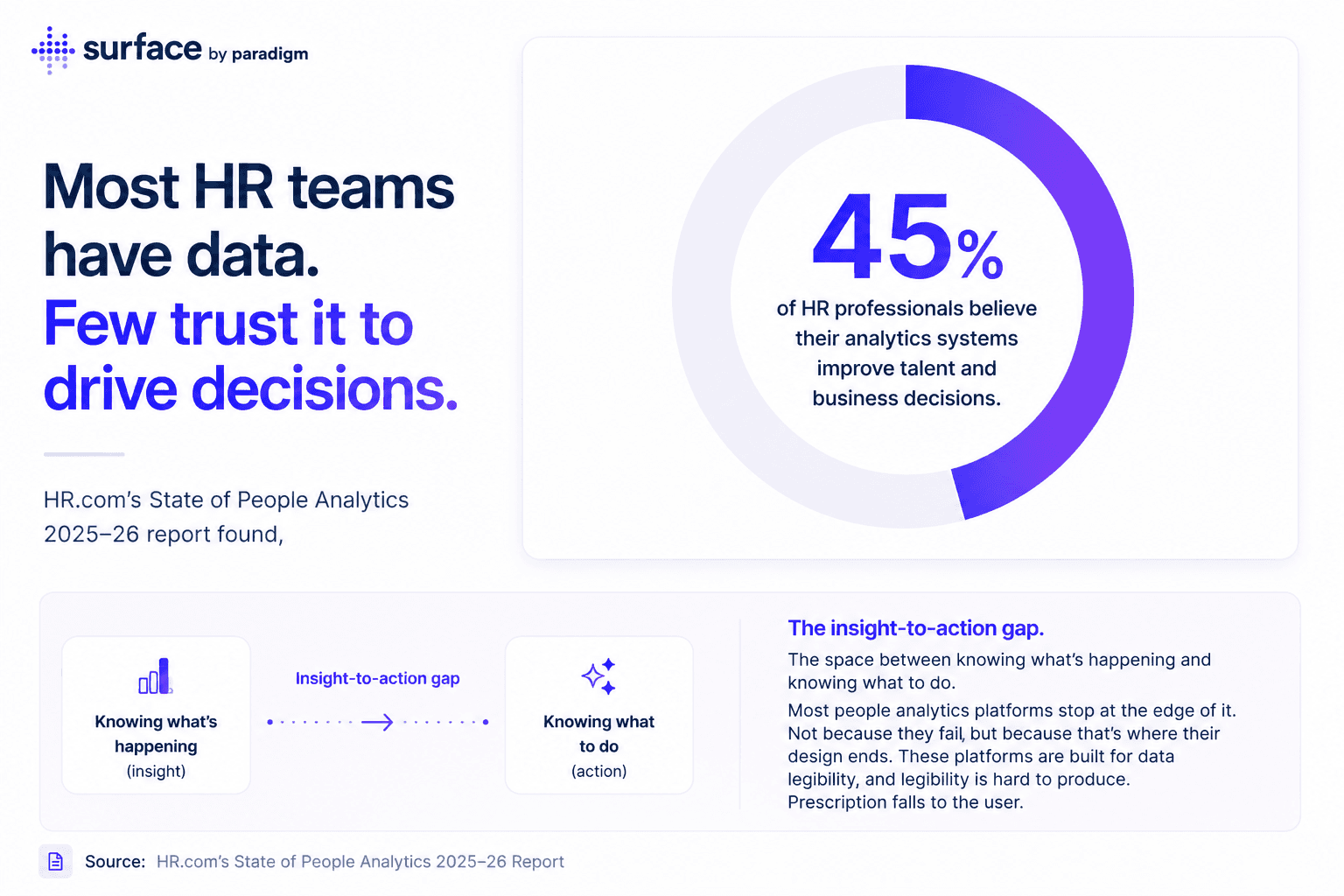
This is the insight-to-action gap: the space between knowing what’s happening and knowing what to do. Most people analytics platforms stop at the edge of it. Not because they fail, but because that’s where their design ends. These platforms are built for data legibility, and legibility is hard to produce. Prescription falls to the user.
As the analytics category has matured, most platforms have optimized for visibility: making workforce data available, navigable, and trustworthy. The space that combines multi-signal insights with the ability to translate those insights into actionable strategy is nearly empty. That’s where Surface operates.
Seeing the Problem Clearly Isn’t the Same as Solving It
This gap exists by design, not by failure. People analytics platforms are built by data experts optimized for legibility, a difficult and valuable engineering problem. The tradeoff is that prescription requires a different kind of knowledge: what works for organizations in similar situations, what peers are doing, and what the evidence says about this specific pattern in this specific context.
People analytics platforms surface meaningful patterns across rich multi-source data. That’s their job, and they do it well.
But turning a pattern into a recommended action requires:
Organizational context: What’s already been tried, what the culture can absorb
Peer benchmark data: What are comparable organizations doing with the same pattern
Synthesis across signals that live in different systems
That combination is what produces an actionable recommendation, and it’s a distinct problem from the visibility challenge the analytics platform was built to solve.
And while many HRIS platforms feature AI capabilities now, it may not be enough to continue improving human performance. Deloitte’s 2026 Global Human Capital Trends report found that organizations can no longer rely on technology differentiation to drive competitive advantage, but instead must cultivate their “human edge.”
Technology can show what’s happening in the workforce. Deciding what to do next is often the harder part.
That’s why generic AI for HR added to a data platform doesn’t automatically close the insight-to-action gap. It can generate frameworks, but those frameworks don’t account for your organization’s context, peer benchmarks, or the institutional knowledge that shapes how culture actually operates.
AI still needs meaningful context to synthesize against. That’s what’s missing.
What an Intelligence Layer Actually Does
The distinction between visibility and action sounds subtle until you look at the questions each tool is designed to answer.
Visibility answers “What happened?”
People analytics platforms are built to help organizations understand workforce trends. They pull together data from across the HR stack and make it easier to spot patterns that might otherwise go unnoticed.
Typical questions include:
Who is leaving?
Which teams are becoming less engaged?
Where are performance scores changing?
Which business units are experiencing higher turnover?
How do outcomes differ across departments or employee groups?
Those are important questions. Without reliable visibility into workforce data, organizations often end up relying on anecdotes, assumptions, or isolated observations. People analytics platforms create a shared understanding of what’s happening across the workforce and help leaders make decisions from a common set of facts.
But visibility works on your schedule, not the data’s. The pattern sits in the dashboard until someone opens it, builds the right view, and works out what the numbers mean. The signal exists whether anyone’s looking or not. Whether you catch it depends on who logged in this week and what they thought to check.
Intelligence answers “What should we do next?”
This is where visibility and intelligence separate, and it happens earlier than most evaluations assume.
An intelligence layer doesn’t wait to be queried. It watches the signals across your connected systems and brings the important ones forward while they’re still forming. When attrition starts climbing in a specific business unit, you hear about it as the trend begins, not two quarters later when a dashboard review catches up to it. Intelligence names the teams affected, points to the likely drivers, and tells you what to do next.
That changes the timing of every decision that follows. You’re responding to a trend you can still influence instead of explaining one that already cost you eight engineers.
Surfacing the signal is only the first half of the job.
Once an organization knows engagement is declining or attrition is increasing, the next questions become harder. Why is this happening? How unusual is it compared to peer organizations? Which intervention is most likely to work? What should happen first? What can wait?
Those questions require a different kind of system.
An intelligence layer helps leaders move from observation to decision. Rather than simply surfacing patterns, it helps interpret them in context. That includes connecting signals across different systems, incorporating benchmark data, identifying likely drivers, and prioritizing actions based on their expected impact.
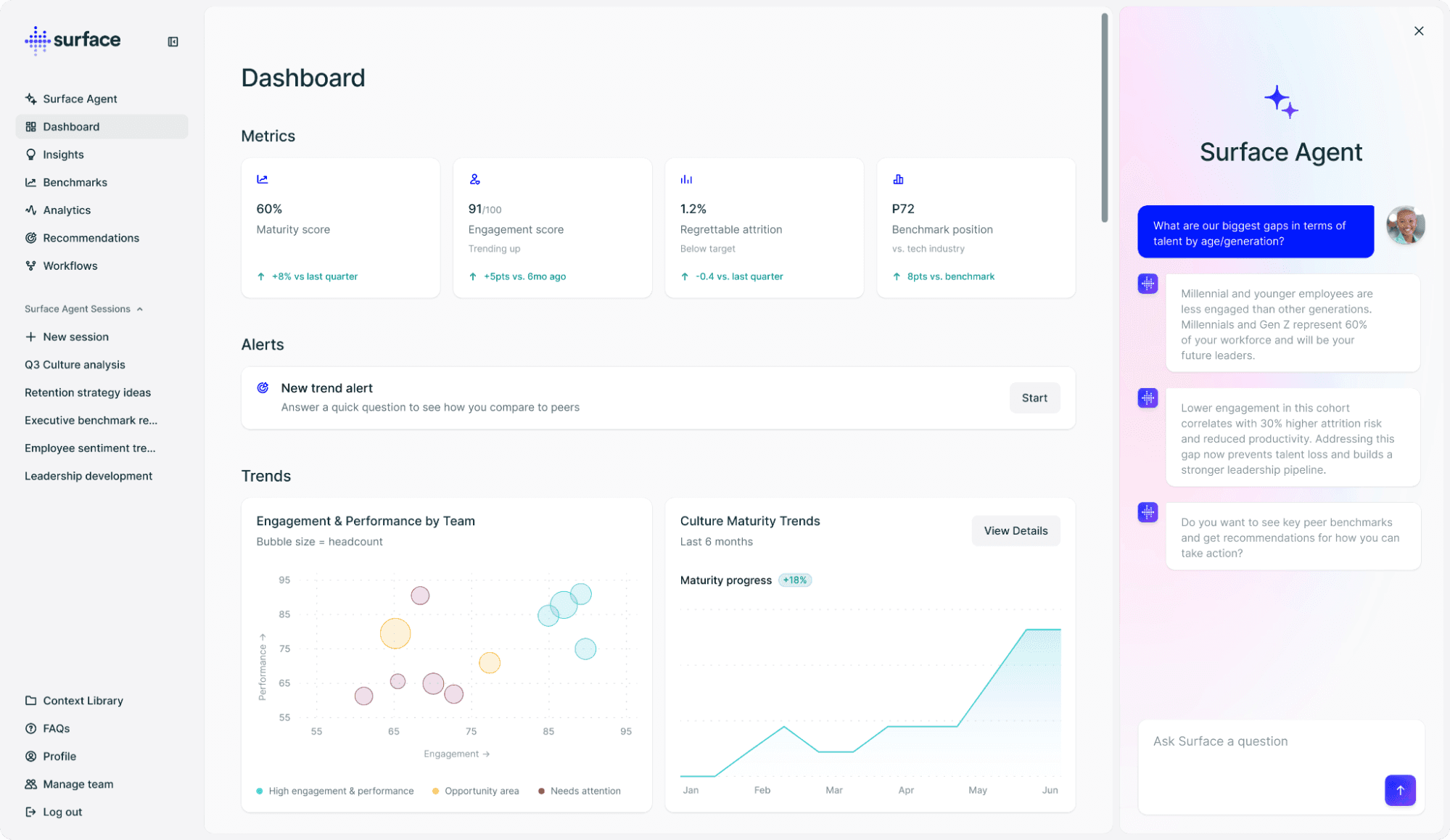
In practice, that means helping leaders answer questions such as:
What are organizations like ours doing in response to this issue?
Which factors appear to be contributing most to this outcome?
Which actions are likely to have the greatest impact?
What should we prioritize over the next 30, 60, or 90 days?
How do we translate this insight into a plan the organization can execute?
Execution turns decisions into outcomes
The final step is often where progress slows down.
The hardest part of most people initiatives is rarely identifying the issue. It’s moving from diagnosis to action. Policy updates need to be drafted. Managers need guidance. Communication plans need to be built. Executive stakeholders need updates. Teams need a practical path forward.
This work rarely fits neatly into a dashboard. It requires synthesis, prioritization, and execution. That’s why many organizations find themselves with strong visibility into workforce issues but slower progress on addressing them.
That’s the gap between insight and action. It’s also the job an intelligence layer is designed to fill.
6 Signals It’s Time to Add an Action Layer
Most teams don’t outgrow their analytics platform in one obvious moment. They notice it in the workarounds: the deck someone rebuilds every quarter, the initiative that stalls after approval, the trend they caught a month too late.
Each of the following signals points to the same underlying gap, and none of them get solved by better dashboards. If you recognize two or three, you’re past a visibility problem.
1. Your team spends more time translating data than acting on it
Analysts are building decks to explain what the dashboard already shows. People leaders are spending half their board prep turning metrics into narrative. The platform has surfaced the signal, but the work of translating that signal into a decision still sits with the team.
2. You make decisions without the peer context to justify them
Engagement scores dropped 6 points. Is that a crisis or within normal variation?
Without cross-industry benchmarks on the same signal, the number is uninterpretable in isolation. Most HR analytics platforms offer broad industry benchmarks, but not the deeper peer context needed to interpret a specific signal.
3. You find out about problems after they’ve already cost you something
The data was there. Nobody was looking at it on the day it mattered.
This is the cost of a reactive setup. Your dashboard holds the answer, but it only speaks when someone opens it, builds the right view, and reads the trend correctly. So the engineering attrition spike shows up in a quarterly review, months after the first three resignations, and by then you’re not managing a trend. You’re managing an exit wave.
Reactive discovery puts a floor under how fast you can respond, and that floor is set by your review cadence rather than by the problem. Proactive surfacing removes it. If you’re consistently learning about workforce issues late enough that your options have already narrowed, the gap isn’t in your data. It’s in what’s watching it.
4. Approved initiatives take quarters to execute
Analysis done. Leadership aligned. The policy draft, training curriculum, or comms package is still in someone’s queue three months later.
The analytics platform stops at the recommendation. The execution work (writing, designing, sequencing) begins on the other side of a gap that no one has bandwidth to cross.
5. Your highest-value insights require context that isn’t in your HRIS
The attrition signal is clear, but the explanation isn’t, because the real drivers live in exit interview themes, performance review patterns, one-on-one feedback, and organizational context that often sit outside the systems being analyzed. The signal points somewhere the platform can’t follow.
6. Your executives want outcomes, not trend lines
Board reporting on workforce metrics is increasingly expected. Building a board-ready deck from a dashboard is significant manual lift every quarter. Trend lines need context, priorities, and recommendations that executives can act on.
Choose the Right Tool for the Right Job
These tools aren’t competitors. They solve different problems. The table below shows where a people analytics platform typically ends and where an action layer begins.
This isn’t about replacing one with the other. It’s about knowing which job each tool is built to do.
Go From “Here’s What’s Happening” to “Here’s What We’re Doing”
An engagement survey closes. The analytics platform surfaces the signal: manager effectiveness scores are down 8 points, concentrated in Engineering. The driver is unclear, whether workload, communication style, unclear direction, or some combination. The platform has done its job: it surfaced the signal, localized it, and made it visible.
That’s where the platform’s job ends.
Surface picks up from there. It runs a prioritized root cause analysis, drawing on engagement data, available 360 feedback, and benchmark context from peer organizations.
From that analysis, it produces a 30/60/90 action plan tied to the behaviors flagged in Engineering, a manager training curriculum targeting the identified gaps, and a full change communications package: the all-hands email, manager talking points, and FAQ for affected employees.
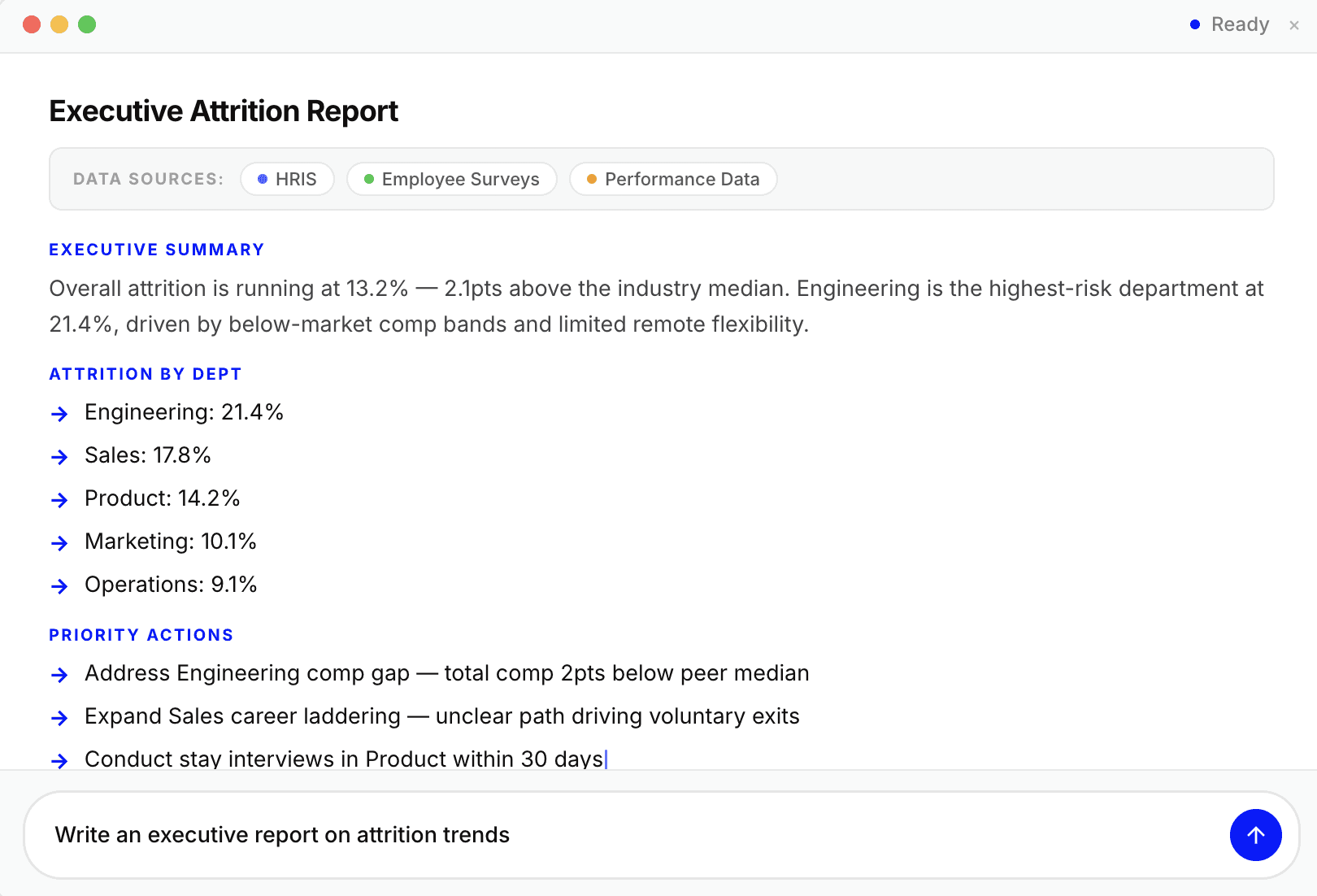
The output is ready for review. It’s not a starting point for weeks of drafting, but a deliverable to act on.
Questions to Ask Before Your Next HR Platform Decision
Use these in your next internal evaluation conversation.
What does success look like 12 months from now: more visibility, or faster execution on what the data reveals? The answer will help clarify whether your next investment should focus on understanding workforce trends or acting on them more effectively.
How much of your current analytics output is being translated into action, and by whom? If significant time is spent turning insights into plans, communications, and recommendations, that work may be revealing a gap in the current process.
Do you have the peer benchmarks you need to justify your initiatives internally? If not, what would change if you did? Does your current platform provide them?
Where does your current tooling stop, and what happens at that point? Mapping this honestly reveals the gap and identifies who is currently absorbing the cost of bridging it.
If you’re considering both a people analytics platform and Surface, which comes first, and what does each need from the other to work well? For organizations with an existing analytics platform, Surface integrates with the existing stack and picks up where visibility ends, and action begins.
Surface Is Your Decision and Execution Layer
Surface was built for the job that begins where analytics platforms end. It connects HRIS data to engagement surveys, performance metrics, exit interviews, policies, benefits, and institutional knowledge: the unwritten practices that shape how culture actually operates and typically only live in people’s heads.
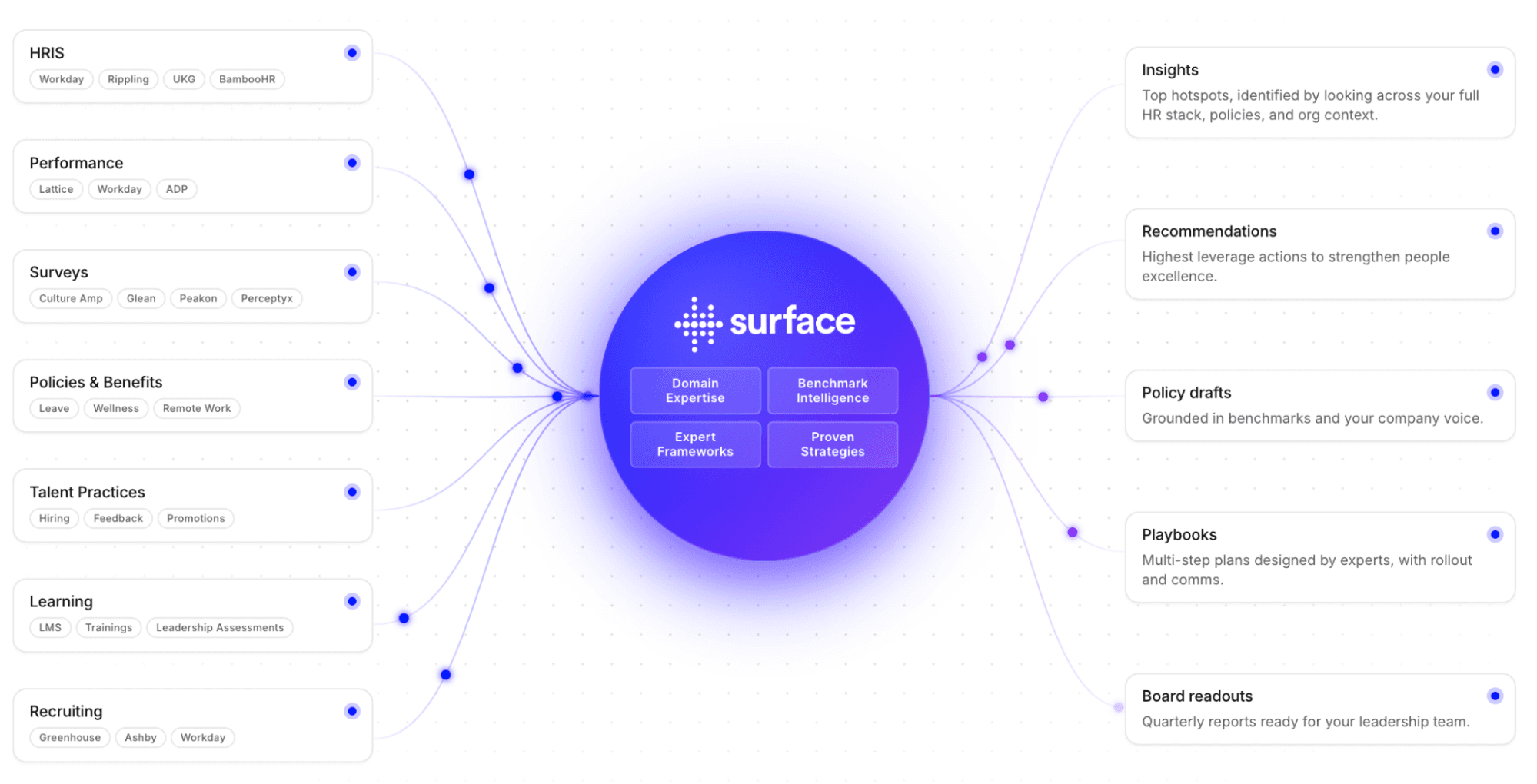
The benchmark foundation is 12+ years of Paradigm’s consulting work across thousands of organizations. When Surface produces a recommendation, it draws on proprietary data about what’s worked across organizations in similar situations, not generic management content repackaged as AI output.
For organizations that already have a people analytics platform: Surface integrates with the existing stack and picks up at prescription. The result is a faster path from insight to action.
The question isn’t whether to have data visibility. Every serious HR organization needs it. People analytics platforms do an essential job. Surface does a different one.
Organizations using Surface cut the time between diagnosis and deployed action plan by 2 to 3x. That gap, the weeks between “we know what the problem is” and “we’ve moved on it,” is where most people programs lose momentum, leadership confidence, and the window to make an impact.
The organizations that pull ahead will be the ones that figure out the difference early.
See Surface in action, book a demo today.

Paradigm
Paradigm helps organizations solve their hardest people and culture challenges, through expert consulting and advisory work and Surface, our talent and culture intelligence platform.
View all articles
Newsletter
Expert perspectives on workplace culture, in your inbox
Keep reading
More insights

Employee Listening & Culture Data
Manager Effectiveness: How to Diagnose Where Your Managers Are Stuck
Learn how to identify manager effectiveness gaps using connected workforce signals, before they show up as exits. A diagnostic framework for CHROs and CPOs.
Employee Listening & Culture Data
Dashboards vs. Decisions: When to Use a People Analytics Platform—and When You Need Surface
People analytics platforms show what's happening. Surface shows you what to do about it. A framework for HR leaders who need both and know the difference.

Employee Listening & Culture Data
Portfolio Intelligence: The People Metrics Private Equity Firms Should Be Monitoring
PE firms monitor financial performance across the portfolio. Most don't have the same visibility on people metrics. Here's the framework and why it matters.